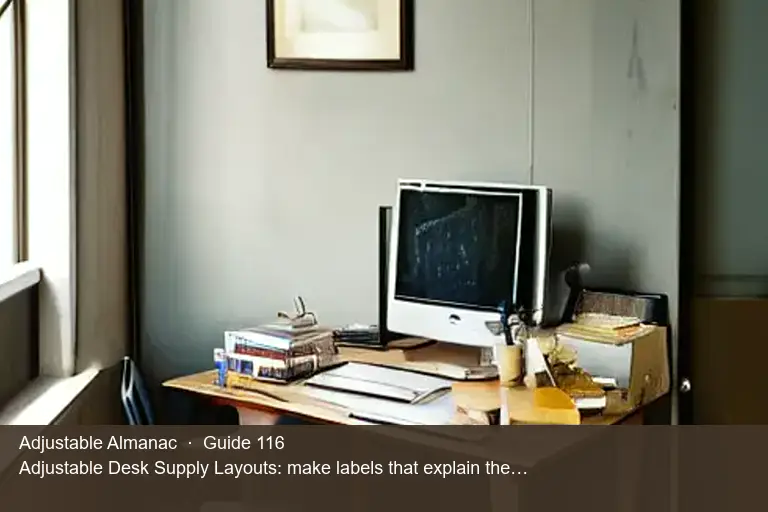
Adjustable Desk Supply Layouts: make labels that explain the system — reuse review for a changing inventory; setup at seasonal changeover
Adjustable desk supply layouts are an essential part of modern home offices and commercial spaces, providing flexibility to adjust supply to meet changing needs. However, these systems are not always easy to explain to customers or maintain. This article provides practical steps for making labels that explain the system, so that the changeover can be completed smoothly and effectively. The process is simple and can be done in a few steps, making it accessible to a wide audience, including those aged 50+ in the US and Canada.
The first step in making labels that explain the system is to identify the key elements that must be explained. These include the different supply categories, such as paper, ink, and paint, as well as the specific labels that need to be adjusted. It is important to note that labels need to be clear and concise, so that customers can understand the differences between the different supplies and what adjustments are required.
The second step is to gather all the relevant information and documentation that needs to be explained. This includes the names, descriptions, and dimensions of each label type, as well as the specific adjustments required. It is also important to ensure that all the information is relevant and up-to-date, with the latest information available.
The third step is to create a clear and concise label that explains how the system works and how adjustments are made. The label should be easy to read and understand, with clear instructions on how to adjust the supply categories and specific labels. It is important to use simple language, with plenty of white space, so that the label can be easily read and understood.
The fourth step is to test the label with a variety of labels to make sure that it meets the requirements. It is important to test the label in different environments, such as on different surfaces, so that it can be easily understood and used in different situations. If necessary, the label can be adjusted to meet the needs of the customer.
The fifth step is to provide the label to the customer, who can then use it to explain how the system works and how adjustments are made. The label should be easy to use, with clear instructions on how to adjust the supply categories and specific labels. It is also important to ensure that the label is easy to read and understand, with plenty of white space and clear instructions on how to adjust the supply categories and specific labels.
The sixth step is to follow up with the customer after the changeover to ensure that they are using the system correctly and that any issues have been resolved. It is important to provide the customer with a clear explanation of how the system works, what adjustments are required, and how to adjust the supply categories and specific labels.
In conclusion, making labels that explain the system is crucial for the successful completion of seasonal changeovers. These labels provide clear instructions on how to adjust the supply categories and specific labels, making it easy for customers to understand the changes and make the necessary adjustments. By following the steps outlined in this article, readers will be able to make accurate labels that explain the system and ensure a smooth changeover.