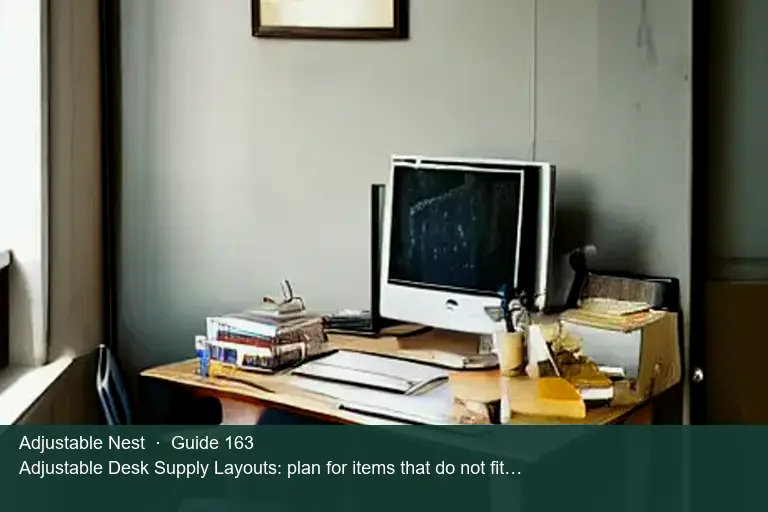
Adjustable Desk Supply Layouts: plan for items that do not fit — time estimate for a narrow space; setup in small spaces
Adjustable Desk Supply Layouts: Plan for Items That Don’t Fit — Time Estimate for a Narrow Space
As you adjust your living space, it’s essential to consider how to fit your furniture and items into your available space. This task involves adjusting the layout of your adjustable desk supply to accommodate items that may not fit comfortably. Understanding the available space and the specific items that may not fit is crucial to creating a functional and efficient layout. In this article, we'll explore how to adjust your adjustable desk supply to fit various items that may not fit, and provide a time estimate for a narrow space.
Before you begin, it’s important to note that adjusting your layout is a process of elimination, where you eliminate items and add new items until the space is fully utilized. This process requires patience, planning, and consideration of the specific items that may not fit. By understanding the available space and the specific items that may not fit, you can create a layout that is both functional and aesthetically pleasing.
Step 1: Assess the Available Space
Before you start adjusting your layout, it’s essential to assess the available space. This involves measuring the available length and width of your space to determine how much space you have available. You can use a measuring tape or a measuring device to measure the length and width of your space. This will help you determine how much space is available and how much space may be wasted due to items that do not fit.
Step 2: Identify the Specific Items That May Not Fit
Once you have assessed the available space, it’s time to identify the specific items that may not fit. This involves evaluating the items that you have and assessing how much space each item takes up. This can be done by measuring the length and width of each item and dividing the length by the width to determine the number of items that can fit in the space. This will give you an idea of how much space is available and how much space may be wasted due to items that do not fit.
Step 3: Create a Plan for Adjusting Your Layout
Now that you have assessed the available space and identified the specific items that may not fit, it’s time to create a plan for adjusting your layout. This involves making a list of the specific items that will fit in the space and the specific items that will not fit. This will help you determine how much space will be used and how much space will be wasted. You can use a drawing or a layout to help you visualize the layout and determine how much space will be used and wasted.
Step 4: Adjust Your Layout
Once you have created a plan for adjusting your layout, it’s time to adjust your layout. This involves making changes to your layout until the space is fully utilized. This can be done by adjusting the length and width of your space until the space is fully utilized. You can use a measuring tape or a measuring device to measure the length and width of your space and adjust the layout until the space is fully utilized.
Step 5: Evaluate the Result
After you have adjusted your layout, it’s time to evaluate the result. This involves measuring the space again to determine how much space is used and how much space is wasted. You can use a measuring tape or a measuring device to measure the length and width of your space again and evaluate the result.
Step 6: Repeat the Process
As you continue to adjust your layout, you can repeat the process until the space is fully utilized. This can be done by adjusting the length and width of your space until the space is fully utilized and evaluate the result. This will help you create a layout that is both functional and aesthetically pleasing.
Conclusion
In conclusion, adjusting your layout is a process of elimination, where you eliminate items and add new items until the space is fully utilized. By following the steps outlined in this article, you can adjust your adjustable desk supply to fit various items that may not fit, and provide a time estimate for a narrow space.